
On 16 September 2026, UNI, the Italian Standardisation Body, hosted the workshop “Industrial Symbiosis for Sustainable Cities and Communities – Standardisation meets innovation: from circular ideas to market-ready solutions”, organised under the EU-funded United Circles project.
Held in Milan in a hybrid format, alongside the project’s General Assembly, the event brought together representatives of the European Commission, standardisation experts, researchers, industry stakeholders and international organisations to explore how industrial-urban symbiosis can contribute to more sustainable, circular and resilient cities and communities. The workshop provided an opportunity to discuss how standardisation can help bridge the gap between research, innovation and practical implementation, supporting the development and wider uptake of industrial symbiosis solutions.
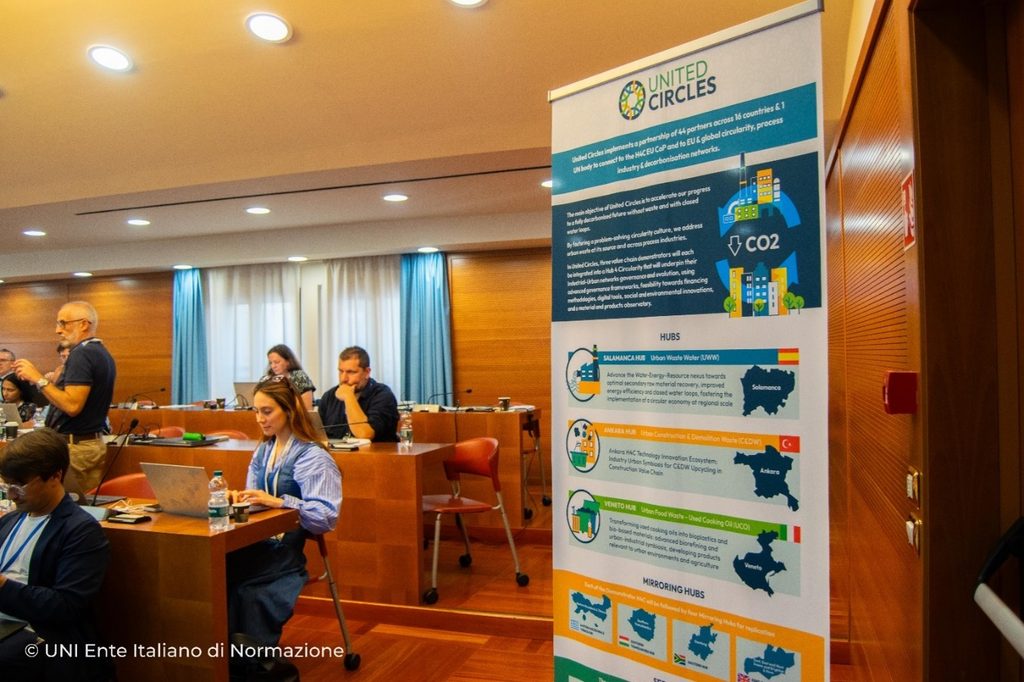
Connecting European priorities, innovation and standardisation
The workshop opened with contributions from Lorenzo Pazzagli (European Commission, DG CLIMA) and Rachel Lombardi (Convenor of CEN/TC 465/WG 4 and CEO of International Synergies Limited).
Lorenzo Pazzagli highlighted the connection between industrial-urban symbiosis, European sustainability objectives and the role of cities in accelerating the transition towards a circular and climate-neutral economy. He emphasised how standards can provide common methodologies, foster stakeholder trust and support the replication of innovative solutions across different territorial contexts.
Rachel Lombardi presented the ongoing standardisation activities within CEN/TC 465/WG 4, “Industrial Symbiosis for Sustainable Cities and Communities”, highlighting the importance of aligning industrial symbiosis approaches with the needs and priorities of cities and regions.
The discussion underlined the importance of standardisation as a bridge between European policy objectives, innovation and the practical implementation of industrial symbiosis.
From United Circles project results to new standardisation opportunities
Francisco Corona (CARTIF), United Circles Project Coordinator, presented the project’s progress and its approach to advancing industrial-urban symbiosis through demonstration hubs, innovative technologies, digital solutions and cross-sector collaboration.
The discussion focused on the project’s demonstration activities and their potential for replication and adaptation across different industrial and territorial contexts.
Roberta Nicastri (ECOWISE) then introduced the United Circles Feasibility-to-Finance Framework, a structured methodology designed to support the development of industrial-urban symbiosis initiatives from their initial concept to an investment-ready proposal.
Organised into three phases and eight steps, the framework addresses technical, environmental, social, economic and financial considerations, helping stakeholders assess project feasibility, manage risks and identify suitable financing opportunities.
The framework is also expected to provide the basis for a new pre-standardisation initiative, developed through a CEN Workshop led by UNI, to translate United Circles research results into a CEN Workshop Agreement (CWA). This initiative represents an important step towards making the project’s knowledge and methodologies accessible to a wider community of stakeholders and supporting their practical application beyond the project.
An interactive dialogue on needs, barriers and priorities
The second part of the workshop featured an interactive round table moderated by Cristina Di Maria (UNI), bringing together perspectives from research, industry, international organisations and the European standardisation community.
Contributions from ENEA, Novamont, Bastas Cimento, UNITAR SCYCLE, the RISERS project and CEN/TC 465 highlighted several recurring challenges affecting the wider implementation of industrial-urban symbiosis.
These included regulatory uncertainty surrounding waste and by-product classifications, the need for stronger collaboration between public authorities and industrial stakeholders, access to financing, and the importance of reliable data and common methodologies for identifying and evaluating industrial symbiosis opportunities.
Participants also discussed the potential of digital platforms and resource-matching tools to facilitate cooperation between different industrial sectors, cities and regions. A recurring message was that technological innovation alone is not sufficient: effective governance, stakeholder engagement, appropriate financial mechanisms and a shared understanding of industrial symbiosis are equally essential to move from individual pilot projects to scalable solutions.
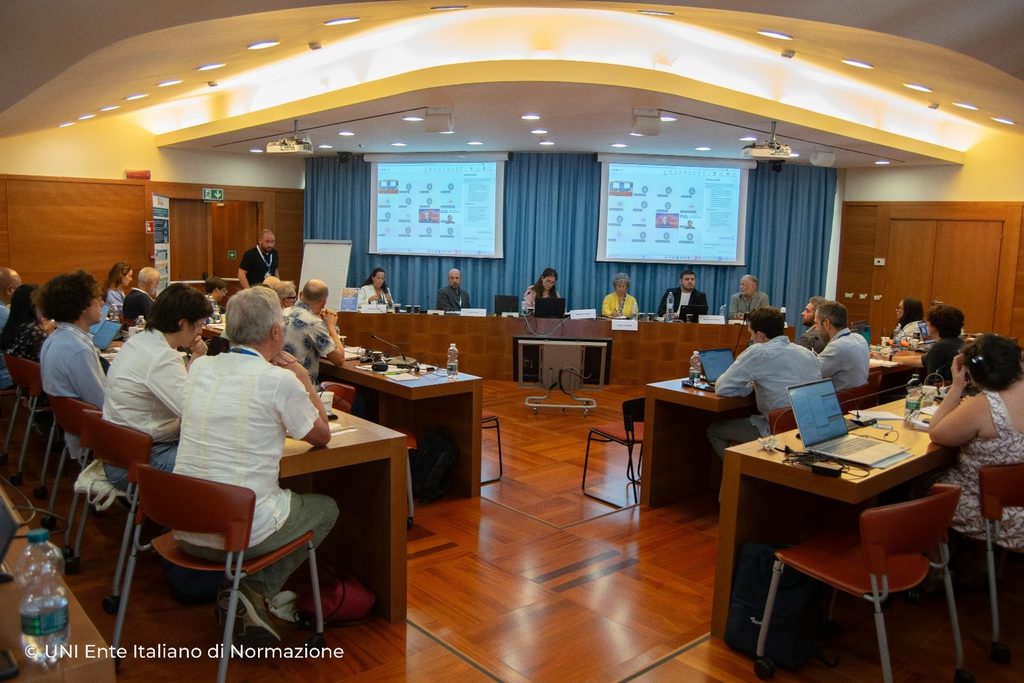
Key takeaways: building a common framework for industrial-urban symbiosis
The workshop highlighted how standardisation can help address the challenges discussed throughout the event by providing common terminology, shared methodologies, and practical guidance, while maintaining the flexibility needed to accommodate different local and industrial contexts.
The discussions also emphasised the importance of involving municipalities, industrial actors and other relevant stakeholders in standardisation activities, ensuring that future standards reflect practical implementation needs.
Through its ongoing activities and the proposed Feasibility-to-Finance CWA, United Circles aims to contribute by supporting the transfer of research results into practical guidance for developing industrial-urban symbiosis initiatives. The workshop reaffirmed the importance of collaboration between research, industry, public authorities, and the standardisation community in turning circular ideas into practical, scalable, investment-ready solutions.
Explore the workshop presentations
Explore the contributions shared by the workshop speakers, covering European policy priorities, ongoing standardisation activities and practical approaches developed within United Circles.
Lorenzo Pazzagli — European Commission, DG CLIMA
The role of the European Commission between policy making and adoption of standards for sustainable and resilient cities
Rachel Lombardi — CEN/TC 465/WG 4 / International Synergies Limited
Standardisation supporting Industrial Symbiosis
Francisco Corona — CARTIF / United Circles Project Coordinator
United Circles project Project Overview
Roberta Nicastri — ECOWISE
The Feasibility to Finance Framework
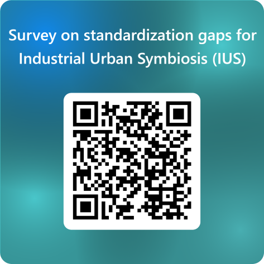
Help identify standardisation gaps in industrial-urban symbiosis
Your perspective can help identify existing gaps and future standardisation needs for Industrial Urban Symbiosis (IUS). Please take a few minutes to complete our survey and share your views.
Complete the survey on standardisation gaps for IUS
Written by UNI