
Guidebook for building a Hub 4 Circularity
Table of Contents
- Why do we need Hubs 4 Circularity?
- What is a Hub 4 Circularity?
- Who can participate in a Hub 4 Circularity?
- What activities do the Hub 4 Circularity partners carry out together?
- What tools and frameworks are available for the Hub 4 Circularity activities?
- How can we structure the activities to work together in a Hub 4 Circularity?
- How do we build the skills to run a Hub for Circularity?
- Glossary/Definitions
Why do we need Hubs 4 Circularity?
Did you know that cities generate more than 2 billion tonnes of waste every year¹ — much of it material that could be feeding industry instead of filling landfill?
And the trend is heading the wrong way. By 2050, the world is expected to generate 3.40 billion tonnes of waste annually, rising sharply from today’s 2.01 billion tonnes. The pressure on our cities, our landfills and our resources is not easing — it is accelerating.
Food waste, wastewater, and construction and demolition debris: urban areas produce a wide range of waste streams, and most of it is buried, burned, or simply mismanaged. It is an environmental burden and, just as importantly, a colossal waste of perfectly usable resources. At the same time, industry keeps reaching for virgin raw materials to make new things — at a pace the planet cannot sustain. Humanity already consumes natural resources around 1.8 times faster than the Earth can regenerate them — as if we had 1.8² planets to draw on. We don’t. We have one, and we are already pushing it to its limit.
What is a Hub 4 Circularity?
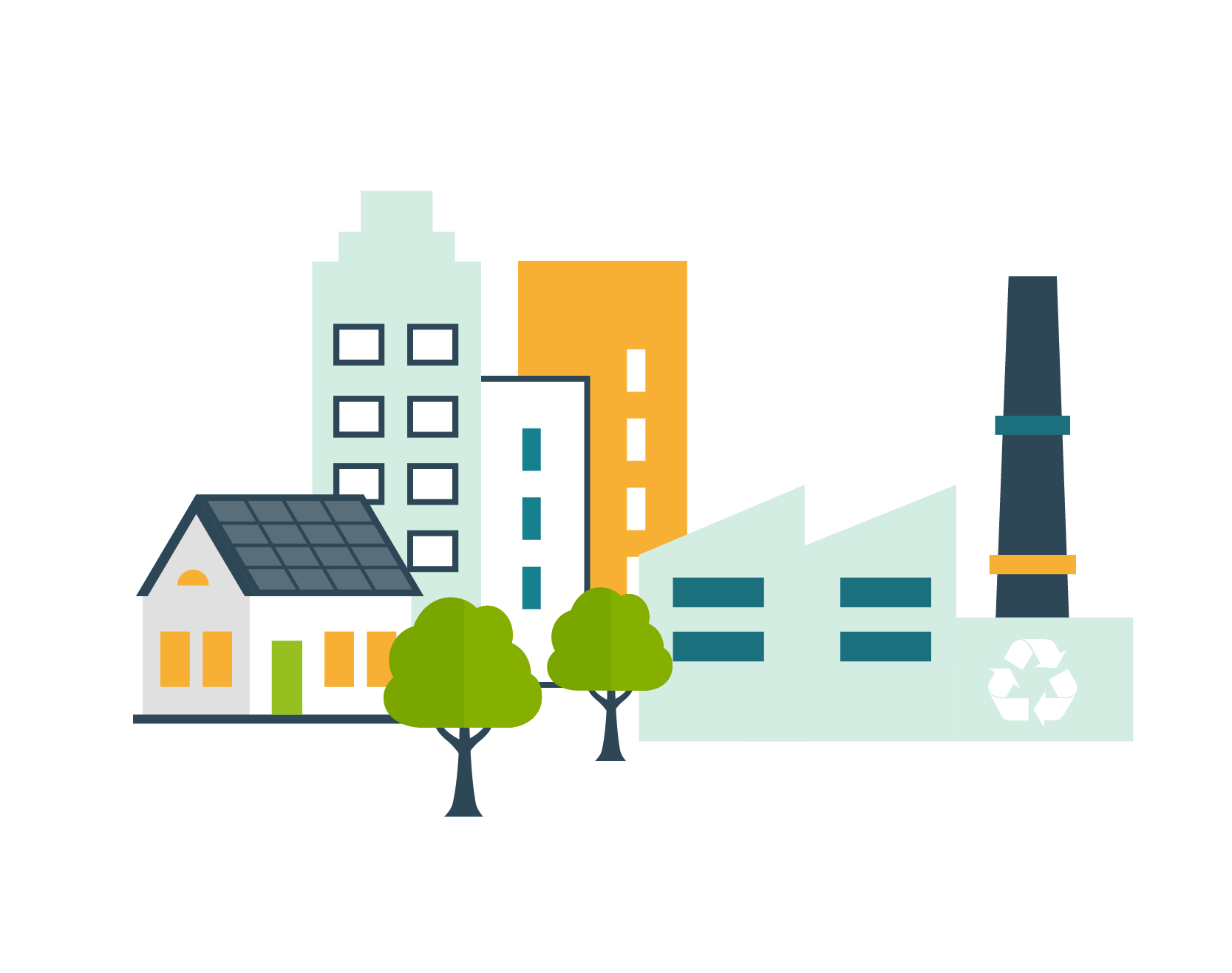
A Hub for Circularity (H4C) is a regional socio-technical ecosystem that enables large-scale industrial symbiosis, industrial–urban symbiosis (IUS), and circular economy solutions by closing energy, resource, and data loops at the territorial level. In practical terms, it is the coordinating platform that connects the actors who generate recoverable resources with those who can use them as industrial feedstock, so that materials which would otherwise reach landfill are kept in productive use.
What distinguishes an H4C from a one-off circular project is its role as an enabling structure rather than a single technology. It brings together governance, stakeholder collaboration, and data-driven decision support to organise dispersed waste streams, technologies, and partners into integrated, investable value chains.

Who can participate in a Hub 4 Circularity?
An H4C is a collaborative ecosystem: a wide range of actors — public institutions, semi-public companies, large industries, SMEs, start-ups, investors and research organisations — working toward a shared vision of sustainable regional development. A hub succeeds only when these actors collaborate actively, contributing not just resources and expertise but also shaping its governance, decisions and daily operations.
To make sense of such a broad network, it helps to group participants by the role they play. Some drive and use the circular value chains; others enable them. Both are essential.
What activities do the Hub 4 Circularity partners carry out together?

Everything a hub does serves a few strategic objectives: advancing industrial–urban symbiosis, closing resource loops, reducing freshwater consumption, and fostering energy co-generation. The activities that pursue them fall into three categories:


What tools and frameworks are available for the Hub 4 Circularity activities?
The Feasibility-to-Finance (F2F) process is more than a sequence of steps — it comes with a practical set of tools and frameworks that equip partners to carry each one out. Tools are the individual instruments a hub uses to map, measure, model and document; frameworks are the structured methodologies that tie those instruments together into a repeatable way of working. None is mandatory: a hub draws on whichever suits the task at hand and the project’s maturity. The tools group naturally into the three phases of the F2F process — Exploration, Assessment and Funding.
How can we structure the activities to work together in a Hub 4 Circularity?

A Hub for Circularity brings together public and private partners with very different resources, objectives and risk appetites. For them to act as one, the way they work together has to be made explicit — through governance (who coordinates, who decides, and how) and through formal agreements (how commitments and contributions are protected). Both share a defining feature: they are not fixed at the outset but mature as the hub does, tightening from loose cooperation into firm structure as a project moves toward investment (Deliverable 2.5).
How do we build the skills to run a Hub for Circularity?
A Hub for Circularity asks a lot of the people who run it. Coordinating industries, public authorities, investors and communities — and steering circular value chains from idea to investment — calls for a blend of technical, regulatory, financial and collaborative skills that few organisations have all at once. Building that capacity is itself a core hub activity, and the United Circles H4C Skills Training Programme (Deliverable 2.7) was designed to do exactly that, for project partners and the external stakeholders working alongside them.
The programme was built from the ground up around real needs. Rather than assuming what hubs should learn, the team ran a structured needs assessment — interviews, co-creation workshops and an online survey across the hubs — to identify where the skills gaps actually were. The answers spanned both the technical (energy and material flow analysis, waste mapping, circular business models, financial planning, ESG reporting, regulatory compliance, risk analysis, KPIs) and the human (stakeholder engagement, communication, collaboration, trust-building). The programme was then shaped and refined to match and mirror hubs, so the content fit real regional and sector contexts.
Glossary/ Definitions

Hubs for Circularity (H4C): industrial clusters that realise lighthouse projects in industrial and industrial-urban symbiosis and circularity of materials and resources.
Seed H4C: a nascent initiative that starts with a small number of committed organisations aiming to evolve into a fully functional H4C.
Mirroring H4C: an ecosystem that seeks to replicate successful industrial symbiosis value chains from established demonstrators.
Demonstrator H4C: a fully operational ecosystem where circular economy solutions are tested and validated at a regional level.
Symbiosis Readiness Level: provides a structured approach to evaluating and guiding the maturity of symbiotic cooperation within a hub, with a focus on stakeholder engagement, infrastructure readiness, operational coordination, and value chain integration.
Vision of an H4C: The vision of an H4C within the framework of IUS is an interconnected system where resources are used efficiently, waste is minimised, and resilient, sustainable environments are created.
Mission of a H4C: The mission of a H4C is to define and pursue clear medium- and long-term goals that contribute to systemic circularity and address regional challenges and opportunities.
CHO: the key orchestrator responsible for managing the H4C’s coordination, strategy, and implementation efforts. As a neutral and trusted facilitator, it connects actors, aligns initiatives, and enables co-investment in shared infrastructures, knowledge, and innovation.


